A streaming policy looks sensible on a steady connection: request a high-quality chunk whenever the recent throughput supports it. Then a slow chunk drains the playback buffer and the video pauses. Was the policy wrong, the predictor wrong, or the evaluation too easy? Before training a better policy, make the accounting inspectable.
Pensieve learns bitrate decisions from player observations and rewards reflecting quality of experience. Its training environment tracks chunk download time, playback-buffer changes, and rebuffering. The paper explicitly examines how transport behavior affects the fidelity of chunk-level simulation. Pensieve, Sections 4.1–4.2.
Pensieve reports 12–25% average QoE improvements across its evaluated trace-driven and real-world scenarios. Its simulator and learning setup matter, including network behavior that can depend on the selected bitrate. The small chunk-index model here tests a narrower question: can two traces with the same bandwidth values produce different outcomes because their order changes the buffer state?
Track seconds of video, not just megabits
Our original model uses two-second chunks at either 1 or 3 megabits per second. A chunk encoded at bitrate r contains 2r megabits. If download throughput is b megabits per second, its download takes 2r/b seconds. During that time the player consumes buffered video.
With buffer B before the download, the stall is max(download_time − B, 0). After completion, the buffer becomes max(B − download_time, 0) + 2. The example caps the buffer at eight seconds by discarding surplus in the model; it does not simulate request-pausing or wall-clock network traces. That simplification keeps this illustration about buffer arithmetic rather than transport behavior.
Take B = 2 and choose a 3-Mbps chunk. At 3-Mbps throughput, download takes two seconds: there is no stall, and the buffer returns to two. At 0.75-Mbps throughput, the same chunk takes eight seconds and causes six seconds of stalling. Its encoded quality has not changed. Its experience has changed dramatically.
Two explicit rules, not a trained neural policy
The Python illustration compares a fixed high-bitrate rule with a buffer rule that requests low bitrate below four seconds of buffer and high bitrate otherwise. Both receive identical synthetic throughput sequences. Each listed throughput is held constant for an entire chunk download, so the sequence is indexed by chunk, not elapsed time. A real time-varying trace would need integration across throughput intervals.
We evaluate steady, alternating-fast-and-slow, and severe-low-throughput cases. The scalar score sums bitrate, subtracts four times stall seconds, and subtracts half the absolute bitrate change. Those coefficients are choices for this example, not measured viewer preferences. The output therefore includes total stalls and mean bitrate alongside the score. Otherwise a policy could hide degraded quality behind fewer stalls, or hide intolerable stalls behind high nominal quality.
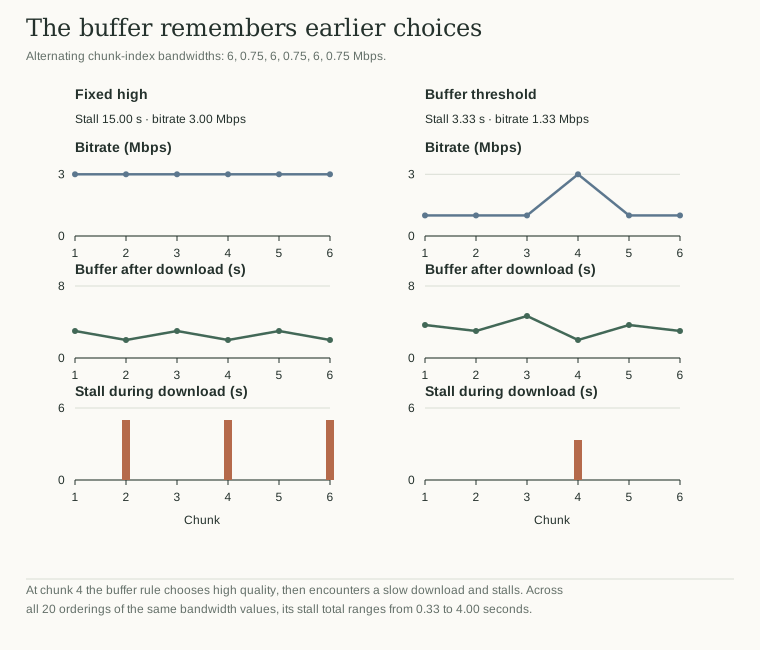
In the executed alternating trace, the fixed-high rule stalls for 15 seconds, versus approximately 3.33 seconds for the buffer rule. The latter also delivers lower mean bitrate: 1.33 rather than 3 Mbps. The figure aligns bitrate and buffer level with stalls on a separate axis. The useful comparison is causal: which earlier choice consumed the buffer that would have absorbed the later slow download?
Generalization is a test design question
These traces are stress cases, not a claim that either heuristic beats Pensieve. No learning takes place in the snippet. The calculation establishes that the interaction between chunk size and accumulated buffer makes decisions sequential, and that reward components can pull in different directions.
For a learned-policy experiment, separate training traces from evaluation traces before tuning the reward or architecture. Hold out whole variability patterns, not merely random adjacent chunks from the same recording. Report performance by network condition as well as in aggregate, and preserve the individual QoE components. That would let a reader distinguish genuine robustness from a favorable average dominated by easy connections.
Hold the bandwidth multiset fixed
There are twenty arrangements of three 6-Mbps values and three 0.75-Mbps values. Each has arithmetic mean 3.375 Mbps. The extension runs both policies on every arrangement, preserving the same initial buffer, chunk duration, bitrate choices, and score coefficients. The fixed-high policy accumulates between 15 and 18 seconds of stalls. The buffer-threshold policy accumulates between one-third of a second and four seconds.
The arithmetic mean is insufficient in two ways. Download time depends on bitrate divided by bandwidth, so even without state, reciprocal bandwidth matters. Holding the entire multiset fixed removes that first difference. Ordering still matters because each download consumes the buffer available at that moment, and the buffer is capped. The experiment isolates this second effect instead of comparing unrelated average rates.
These are chunk-indexed rates, held constant throughout each chunk's download. They are not samples from a wall-clock network trace; a longer download does not advance through additional rate segments. The buffer cap also discards excess simulated buffer instead of delaying the next request as a real player might. Those choices keep the arithmetic bounded and inspectable, but a trace-driven player evaluation should model both behaviors explicitly.
The aligned figure shows the alternating case. The threshold rule accumulates enough buffer to choose 3 Mbps at chunk four, immediately before a slow download. It then stalls despite its generally conservative behavior. That decision sequence is more informative than the final QoE score alone. A robust policy study should preserve bitrate, stall time, and switching cost as separate outcomes and hold out entire network patterns before tuning.