Satellite networking and propagation geometry
When a Longer Space Route Is Faster
An explicit satellite chain shows when faster propagation compensates for the climb to orbit, with Earth-clearance checks for every space link.
A route through satellites can be physically longer than a ground route yet have lower propagation delay. There is no contradiction: propagation time is distance divided by signal speed. The interesting question is whether the faster medium compensates for the climb to orbit and the extra route length.
Handley's 2018 study examines hypothetical low-Earth-orbit routing using historical constellation proposals and explicit inter-satellite connectivity assumptions. Its analysis treats route structure and changing geometry as important to latency; the multipath study repeatedly finds paths and removes their links. Those are modeled configurations, not measurements of today's deployed network. Delay is Not an Option, Sections 2–5.
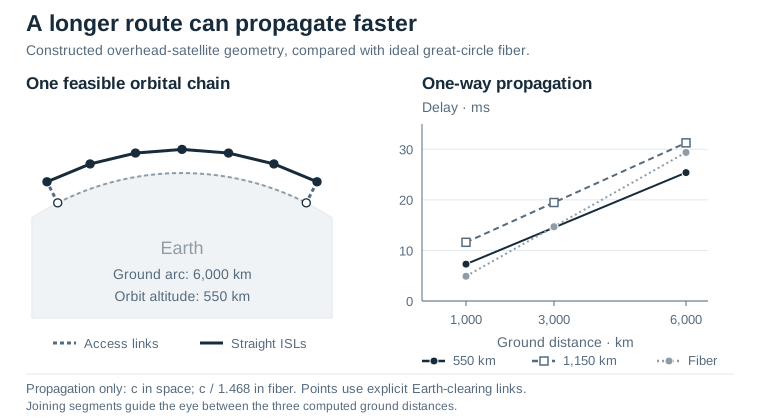
Start with a geometry we can inspect
The illustrative model uses a spherical Earth of radius R = 6,371 km. Two ground endpoints are separated by great-circle distance d. A satellite lies directly overhead at each endpoint, and intermediate satellites lie along the same orbital arc at altitude h. Signals travel vertically up, along straight inter-satellite segments, and vertically down.
For an intentionally simple first estimate, approximate the orbital portion by an arc. Its length is d(R+h)/R, so total space-route length is 2h + d(R+h)/R. Ground fiber follows the surface great circle with no detour. Assume vacuum speed c and an illustrative fiber speed c/1.468. The fiber comparison is unusually favorable to the terrestrial route: it excludes geographic detours and equipment delays.
Under these assumptions, the arc approximation becomes faster when
d > 2h / (1.468 − (R+h)/R),
provided the denominator is positive. At h = 550 km, the crossover is approximately 2,882 km. This is a result of the stated geometry and refractive-index assumption, not a universal satellite-network threshold.
Replace the arc with feasible straight links
Photons do not follow the orbital arc between satellites. For a link spanning central angle δ at orbital radius a = R+h, its length is 2a sin(δ/2). Its closest approach to Earth's center is a cos(δ/2). Requiring that closest approach to exceed R prevents the route from cheating by passing through the planet.
The code divides the total angle into links no wider than ten degrees and checks this clearance condition. It sums their chord lengths, adds the two vertical access links, and converts both space and fiber distances into one-way milliseconds. It repeats the comparison for two altitudes and three ground distances. There is no orbital motion, link-capacity model, shortest-path search, or measured traffic in this calculation.
The access links contribute a fixed climb-and-descent cost that matters most over short ground distances. The inter-satellite portion grows with endpoint separation. Increasing altitude adds access distance and changes the orbital radius, so the faster propagation medium does not guarantee that the space route wins.
A propagation advantage is not an application guarantee
Real end-to-end delay also includes transmission, processing, queueing, and the actual route selected from available links. The overhead endpoint satellites are constructed positions, not an availability claim. A topology with poor directional connectivity can force a longer zigzag even when every individual link is fast.
A network-level comparison needs a time-indexed geometric graph, visibility and link limits, and routes that respond to changing edges. Disconnected periods matter alongside successful paths. The calculation here establishes the propagation tradeoff those routes must respect, while keeping historical research assumptions separate from present-day service performance.
Run the example
The Python 3 example uses only the standard library. The notebook, source, figure data and recorded output are included in the complete bundle.
Inspect the code and recorded output
import math

earth_km = 6371.0
light_km_s = 299792.458
fiber_index = 1.468

def compare(distance_km, altitude_km):
    radius = earth_km + altitude_km
    angle = distance_km / earth_km
    visibility_angle = 2.0 * math.acos(earth_km / radius)
    max_angle = min(math.radians(10.0), 0.99 * visibility_angle)
    hops = max(1, math.ceil(angle / max_angle))
    step = angle / hops
    clearance = radius * math.cos(step / 2.0) - earth_km
    assert clearance > 0.0
    orbital_distance = hops * 2.0 * radius * math.sin(step / 2.0)
    space_distance = 2.0 * altitude_km + orbital_distance
    space_ms = 1000.0 * space_distance / light_km_s
    fiber_ms = 1000.0 * distance_km * fiber_index / light_km_s
    assert orbital_distance <= radius * angle + 1e-9
    return hops, space_ms, fiber_ms

for altitude in [550.0, 1150.0]:
    denominator = fiber_index - (earth_km + altitude) / earth_km
    crossover = 2.0 * altitude / denominator
    print(f"altitude={altitude:.0f}km arc_crossover={crossover:.1f}km")
    for distance in [1000.0, 3000.0, 6000.0]:
        hops, space, fiber = compare(distance, altitude)
        print(f"  ground={distance:.0f}km hops={hops} "
              f"space={space:.3f}ms fiber={fiber:.3f}ms")
print("Earth-clearance and chord-length checks: passed")
Recorded CPU output
altitude=550km arc_crossover=2882.1km
  ground=1000km hops=1 space=7.289ms fiber=4.897ms
  ground=3000km hops=3 space=14.529ms fiber=14.690ms
  ground=6000km hops=6 space=25.389ms fiber=29.380ms
altitude=1150km arc_crossover=8000.2km
  ground=1000km hops=1 space=11.606ms fiber=4.897ms
  ground=3000km hops=3 space=19.473ms fiber=14.690ms
  ground=6000km hops=6 space=31.274ms fiber=29.380ms
Earth-clearance and chord-length checks: passed