Python starts when you choose Run.
When does GPU time-slicing speed up useful feedback?
Original deterministic CPU event simulation; one-second iterations and 0.1-second switches are synthetic.
This notebook runs the complete saved experiment, checks its assertions, and regenerates the SVG from the computed results. Python 3.10+ and standard-library modules only. Place experiment.py and figure_generation.py beside the notebook. The exact loaded assets are recorded in notebook metadata.
q=1: last_first_feedback=8.7, finish=35.1, switches=31
q=2: last_first_feedback=15.7, finish=33.5, switches=15
q=4: last_first_feedback=29.7, finish=32.7, switches=7
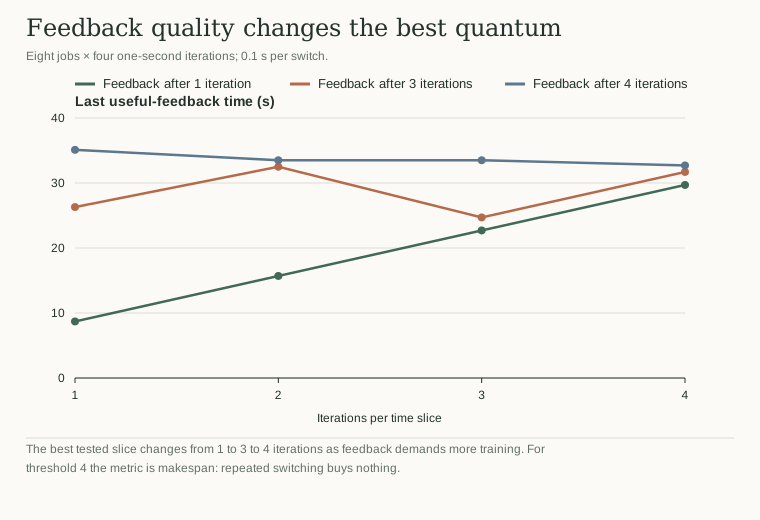
feedback threshold=1: best tested quantum=1, last feedback=8.7s
feedback threshold=3: best tested quantum=3, last feedback=24.7s
feedback threshold=4: best tested quantum=4, last feedback=32.7s
Regenerated figure.svg from results.json.
Inspect the saved result
The article's static figure is available before running code. The regenerated figure.svg uses results.json, and every plotted quantity comes from the experiment.
Change an input in experiment.py, rerun both code cells, then compare the saved result and figure.
Python runs locally in this page. Saved results and figures are visible before execution.